Welcome to MozCache 1.6.2
Dec 17 2021
Version 1.6.2 was released. NEW: Firefox cache index version 0.10 is now supported.
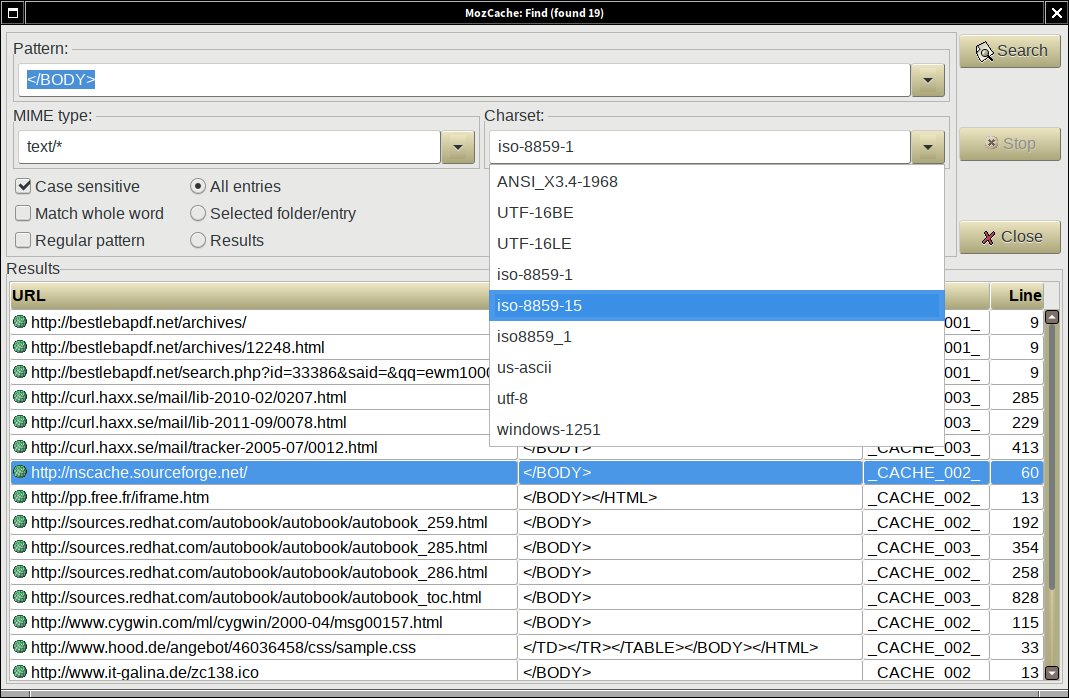
MozCache is a program for UNIX (or Windows if compiled with MingW) and GTK+, which displays the
cache entries of Mozilla, Firefox,
SeaMonkey and both recent and older versions of
Netscape (with Cygwin
or MingW also MS Internet Explorer) web browsers.
The entries can be saved, deleted or viewed with an user assigned application, e.g. a text or an
image viewer, or a browser.
It is also possible to search in the entries, or parts of them, for a pattern like 'www.advertisement.com'
with the options for case sensitivity, to match only the whole word, and to use regular expressions.
MozCache was tested with versions 0.94, 1.7 and 1.73 of Mozilla, versions 4.0, 4.5, 4.72, 4.8, 6.01, 6.1,
6.2.3 and 7.2 of Netscape, version 1.5.01, 2.0, 3.0.1 and 3.5.1 of Firefox, version 1.0, 1.1.16, 2.0.11, 2.4.1,
2.11 and 2.17 of SeaMonkey, and version 5.5 and 7.0 of Internet Explorer with Windows 98/XP/7,
and version 1.5.18-1 of Cygwin.
The new cache2 version was tested with version 2.29 to 2.33.1 of SeaMonkey.
Mozcache 1.4.6 was tested with Firefox 47.0 and SeaMonkey 2.40, Mozcache 1.4.8 was tested with Firefox 48.0, and Mozcache 1.4.9 was tested with Firefox 50.1.0
(Firefox still uses the new cache2 version, but SeaMonkey seems to use the previous one again).
Mozcache 1.5 was tested with Firefox 51.0.1 (second updated cache2), Mozcache 1.5.1 was tested with Firefox 52.0 (third updated cache2), and both with SeaMonkey 2.46.
Mozcache 1.5.2 was tested with Firefox 60.0.1 (updated cache2).
Mozcache 1.6 was tested with Firefox 67.0 and Firefox 68.4.2 (both updated cache2).
Mozcache 1.6.1 was tested with Firefox 74.1 (updated cache2).
Mozcache 1.6.2 was tested with Firefox 91.3 (updated cache2).
Previous versions of MozCache were released as NScache,
which were written by Stefan Ondrejicka.
MozCache is distributed under the terms of GPL2
or later.
To compile MozCache, the following is
- required: ANSI C Compiler (like GCC)
- required: GTK+-1.2, GTK+-2.0 or GTK+-3.0 (or higher versions of them)
- optional: Cygwin (for MS Internet Explorer)
- optional: libintl library from GNU gettext package
(or libc with gettext support - glibc2 or Solaris libc) for internalionalization of the messages
- optional: The zlib library version 1.2.3 or higher
- optional: The brotli libraries
- optional: The iconv library (GTK+-1.2 only)
- optional: Additional the unicode library version 0.4 (GTK+-1.2 only)
- optional: MingW (compile for Windows)
- optional: static libraries needed for GTK-2 (MingW only)
Downloads
Two Linux programs (one for GTK-2, the other for GTK-3) can be downloaded for either 32-bit (227KB)
or 64-bit (226KB).
- Should work with actual distributions (zlib-1.2.11, GTK+-2.24.32, GTK+-3.24.20, and other libraries requiered by GTK)
A native Windows program (32-bit, GTK+-2.24.0) can be downloaded from here (3.5MB).
- All libraries where statically linked, tested with Windows-7 (32-bit) and Windows-11 (64-bit).
The source tarball can be downloaded from here (386KB).
Visit also the MozCache SourceForge summary page for more information.
By the way ...
... if you are looking for a small and easy to use program for cutting videos, then try CutterFF.
It is also open source, and binaries are available for Linux and Windows.
Harald Förster
|
All trademarks and copyrights on this page are properties of their respective owners.
|